The Easiest Way to Remove Hard-Water Stains From Your Toilet
Those chalky rings are mineral deposits, and scrubbing harder rarely helps. Lowering the water and giving a mild acid time to work usually does.
Disclosure: Some product links on this site may earn us a commission. Read our affiliate disclosure.
If your toilet has a stubborn ring that survives every scrubbing, you’re probably looking at mineral scale. Calcium and magnesium left behind by evaporating water build into a rough crust, which can pick up stains of its own: tan, orange, or gray depending on what’s in your water.
Bleach won’t dissolve it, because minerals respond to acids rather than disinfectants. The easiest approach is also the least strenuous: lower the water level, apply a mild acid, and wait.
What you’ll need
- Rubber gloves and eye protection
- White distilled vinegar or food-grade citric acid
- Toilet brush
- Paper towels, or a commercial descaler made for toilets
- Pumice stone (white vitreous china only, see below)
The soak method
- Clear out other cleaners. Flush a few times so nothing is left from a previous product.
- Lower the water. Turn off the supply valve behind the toilet and flush. The water drops, exposing the ring. If any water remains over the stain, a cup or a plunger can push out a little more.
- Apply the acid. Press paper towels soaked in white vinegar directly onto the ring so that the acid stays in contact. Alternatively, dissolve citric acid in warm water according to its package directions and apply it the same way.
- Wait. Give it at least an hour, and several hours for thick deposits. This step does most of the work.
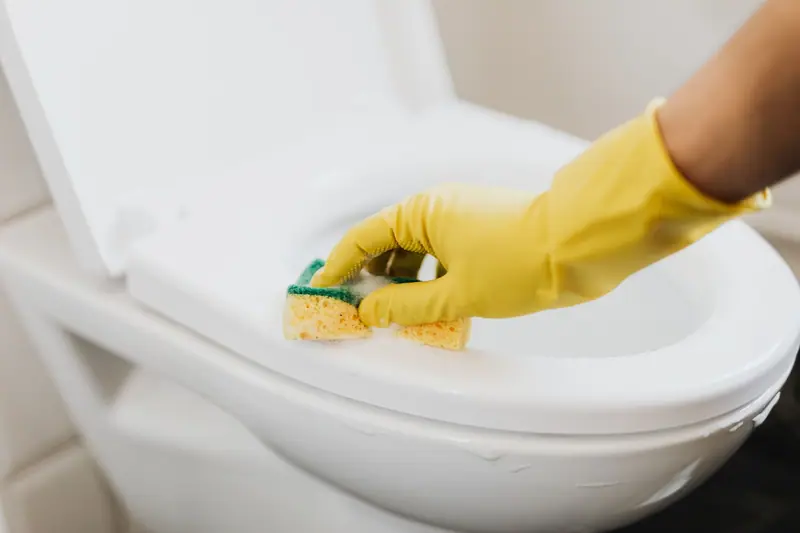
- Scrub. Remove the paper towels and scrub with a toilet brush. Dispose of the towels in the trash, not the toilet, since paper towels can clog the plumbing.
- Restore the water and flush. Open the supply valve, let the tank refill, and flush a couple of times.
- Repeat if needed. Old scale can take more than one round.
If the stain doesn’t budge
Use a commercial descaler
Products labeled for lime, calcium, or rust are stronger than vinegar. Follow the label exactly, respect the contact time, and flush thoroughly. Check that the product is suitable for your toilet and for septic systems if you have one. Keep these products away from bleach, and from children.
Try a pumice stone, carefully
A pumice stone can abrade mineral buildup from white vitreous china. Keep both the stone and the surface wet, use gentle pressure, and stop to check often. A dry stone can scratch, and scratches catch new stains.
Don’t use pumice on colored, coated, or non-china toilets, or on any fixture whose manufacturer warns against abrasives. When in doubt, skip it.
Know when to stop
If deposits are extremely thick or the glaze appears worn, more scrubbing might only damage the surface. A plumber can advise whether replacing the bowl makes more sense.
What to avoid
| Tool or product | Why to avoid it |
|---|---|
| Steel wool or metal scrapers | Can leave gray marks and scratch the glaze |
| Bleach for mineral rings | Doesn’t dissolve scale, and is unsafe near acids |
| Mixing “stronger” combinations | Can release toxic gases |
| Drop-in tank tablets, unless approved | Some can damage tank parts; check the toilet maker’s guidance |
How to keep the ring from returning
- Brush weekly. Light, frequent cleaning stops scale before it hardens.
- Flush guest and rarely used toilets every so often so that standing water doesn’t evaporate and leave a line.
- Fix running toilets. A constant trickle can create a stain track in the bowl.
- Consider your water. If scale shows up on faucets and showerheads too, a home water test can tell you how hard your water is and whether softening is worth looking into.
Frequently asked questions
How long should vinegar sit on a toilet ring?
At least an hour for light deposits and several hours for heavier buildup. Results vary with how thick and how old the scale is.
Will vinegar damage my toilet?
Occasional use on a vitreous china bowl is generally considered fine. Prolonged or repeated exposure may be hard on rubber parts, so keep it in the bowl and out of the tank.
Can I use a pumice stone on any toilet?
No. Use it only on white vitreous china, kept wet and with light pressure. Skip it on colored or coated fixtures.
Is the ring a sign of a health problem?
Mineral scale itself is usually a cosmetic issue. If you see unusual colors or are worried about your water, contact your water utility or have the water tested.
This guide is general information. Your home, appliances, and products may differ, so follow manufacturer instructions and product labels. Spot an error? Tell us, or read our Editorial Policy.